

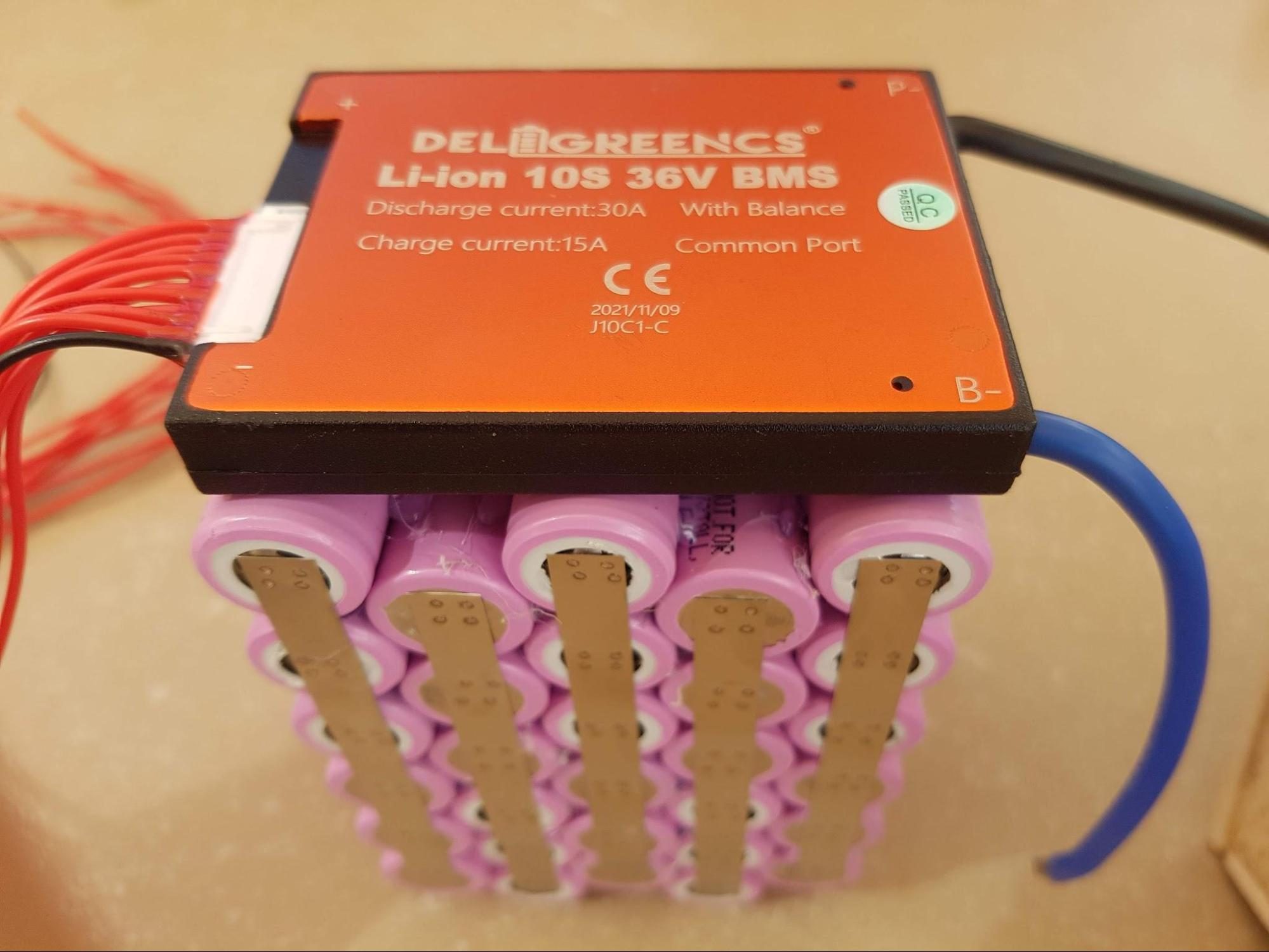
Your battery is charged, the LEDs light up, but the bike shows an error or no longer recognises the battery? Or a battery repaired elsewhere no longer works at all? In many cases, the cells are not to blame: the problem lies with the BMS or the communication between the battery and the bike.
A “smart” BMS with a memory
On simple batteries, the BMS only protects the cells. On branded batteries (Bosch, Shimano, Yamaha, Brose, Stromer and many others), it is a genuine little computer. It records:
- the number of cycles and the estimated capacity;
- the error history (overheating, deep discharge, overcurrent…);
- the state of charge, calculated by counting the energy going in and out;
- often a serial number that the bike recognises.
This electronics is designed never to lose power. It is constantly supplied by the cells themselves, from day one until the end of the battery’s life.
Why the BMS locks up when cells are replaced
To replace the cells, the BMS has to be separated from the old pack. If this is done carelessly, the BMS loses power. When it restarts, on many branded batteries:
- it treats the power loss as a serious fault (as if the battery had been drained to 0 V or short-circuited);
- it goes into a safety lockout and refuses to deliver current, even with new, fully charged cells;
- or it restarts with nonsensical values: wrong capacity, state of charge and counters.
This lockout is a safety feature intended by the manufacturer: a deeply discharged battery can be dangerous, and the BMS cannot tell it apart from a workshop repair. Depending on the model, it is hard or even impossible to clear without the manufacturer’s tools.
Our method: throughout the whole job, we keep the BMS powered from an external source at the correct voltage, group by group, so it never notices the cells being swapped. This is one of the reasons a branded battery is not repaired like a generic one.
Communication errors, a classic
On a modern e-bike, the battery does not just supply current: it talks continuously to the motor and display over a data bus (often CAN or a serial link). The motor checks that the battery is the right one, asks for its state of charge and temperature, and cuts the assistance if it gets no answer.
Typical symptoms:
- the battery is full, but the display says “battery not recognised” or shows an error code;
- the assistance cuts out intermittently, especially over bumps or cobblestones;
- the displayed percentage jumps around or stays stuck;
- the bike works with another battery, but not with this one.
Most common causes:
- oxidised or dirty contacts on the battery or its mount (moisture, pressure washing);
- bent or worn communication pins in the connector;
- a pinched or broken communication wire, inside the battery or in the frame;
- a BMS in protection mode after a deep discharge, a fall or a botched repair;
- a BMS replaced with a generic one: it delivers current, but does not speak the bike’s “language”, so the bike refuses to start.
How we fix these faults
- Diagnosis: measuring each cell group, checking the BMS, connector and communication lines.
- Cleaning and repair of contacts and wiring when that is the cause.
- Cell replacement while keeping the original BMS powered, to preserve communication with your bike.
- Bench test with a full charge and discharge cycle.
After a cell replacement, the charge indicator may need one or two full cycles (charge to 100 %, then ride normally) to recalibrate: this is normal.
Good to know
- If a bike shows a battery error, first try another compatible battery if you have one: you will know straight away whether the problem is the battery or the bike.
- Never leave your battery empty for weeks: it is the number one cause of a locked BMS (see our battery care tips).
- Avoid DIY repairs on a branded battery: disconnecting the BMS just once can render the battery unusable.
Is your battery no longer recognised or locked? Contact us: it can often still be saved.