

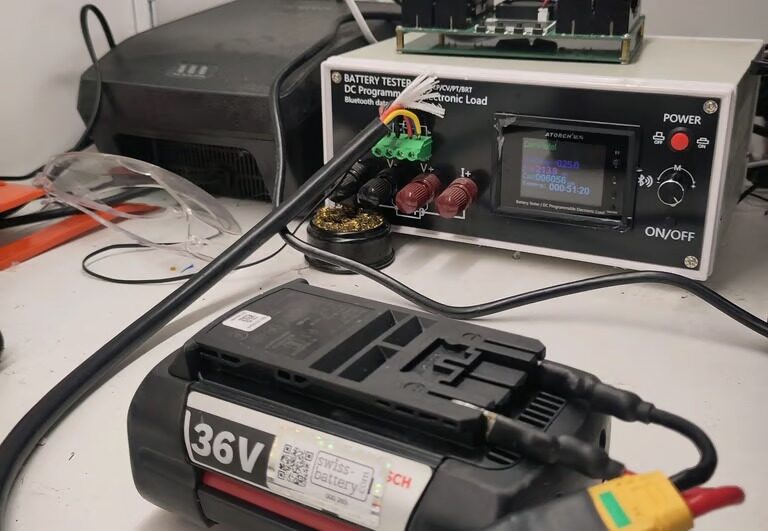
An electric bike battery wears out silently: its range gradually decreases, and you often only realise this when the weather turns cold. At Swiss Battery, we don’t guess at a battery’s condition – we measure it. Here’s how a diagnostic check works and why November is a good time to have one done.
Why it’s important to check your batteries before winter
In cold weather, a battery performs less well: its range decreases, and a battery that is already worn out shows this even more. If it starts to fail in the middle of winter, you risk being left without power at the worst possible moment, or riding without realising what’s going on.
Knowing the condition of your battery in November allows you to make a calm decision: carry on riding, keep an eye on it, or plan for maintenance before you really need it.
What we check at the workshop
A diagnosis is based on three interrelated factors.
- Actual capacity: the battery is discharged on a tester, which indicates the capacity it actually delivers, expressed in mAh. This is the most meaningful measurement, as it can be compared with the original capacity.
- The BMS: this is the electronics that monitors and protects the battery. We check that it is working and communicating correctly.
- The cells: we check their condition and balance. In a pack, the cells are grouped together, and these groups must remain consistent with one another.
| What we look at | What this tells us |
|---|---|
| Capacity in mAh | How much power the battery still has left |
| BMS | Whether the protection and communication functions are working |
| Cells and clusters | Whether wear is uniform or whether a fault has developed |
Why capacity matters more than the label
Appearances can be deceiving. A battery may show a full charge but still drain quickly when going uphill. Conversely, a battery that seems erratic may simply have a BMS that has gone into safety mode.
Only by carrying out a test can you distinguish between normal wear and tear and a genuine fault. To better understand these concepts, you can read our guide on how a lithium-ion battery works.
Signs that indicate a diagnostic check is needed
Please bring your battery to us if you notice any of the following signs:
- a significantly shorter range than before;
- the power assist cutting out on hills or when accelerating;
- a charger that indicates the charge is complete very quickly, or that never finishes;
- an error message or a battery that refuses to start (see our advice on BMS lock-up);
- a battery that has been left discharged for a long time.
Important: if the battery is misshapen, swollen, very hot or gives off an unusual smell, stop using and charging it, and contact us. Never attempt to open or repair it yourself: a lithium battery requires equipment and safety precautions that only a specialist workshop is qualified to handle.
What happens after the test?
Once the result is known, we’ll explain it to you in simple terms, without any technical jargon. There are several possible scenarios:
- The battery is in good condition: you’ll leave feeling reassured, with some advice on how to use it (see how to look after your battery).
- The capacity has dropped, but the battery pack is still in good working order: you’ll know where you stand and can plan ahead.
- The cells are worn out: we can offer a reconditioning service. We then replace all the cells in the pack – never just a single group – and retain the original casing, connector and BMS, which we keep powered throughout the process. The reasons are detailed in our advice on replacing all cells.
- The battery is deeply discharged: it can often be salvaged, but this can only be determined after inspection.
After reconditioning, each battery undergoes a new capacity test. It is issued with a certificate and a QR sticker, which allows you to view its details on the [My Battery] page (/ma-batterie/).
How to send it to us
You can drop off your battery at the workshop in Prilly, just outside Lausanne. If you live further away, you can also send it to us by post, but please contact us first: lithium batteries must be transported in approved packaging, and we will advise you on the procedure to follow.
In summary
- The diagnostic test measures the actual capacity of the battery, checks the BMS and examines the cells.
- Cold weather reveals worn-out batteries: November is the right time to have them checked.
- Never attempt to open or repair a lithium battery yourself.
- Depending on the result, we’ll advise you to: carry on using it, monitor it, or have it reconditioned, with all cells replaced.
Want to find out how your battery is holding up before the cold season sets in? Contact the workshop to drop it off or send it to us.