

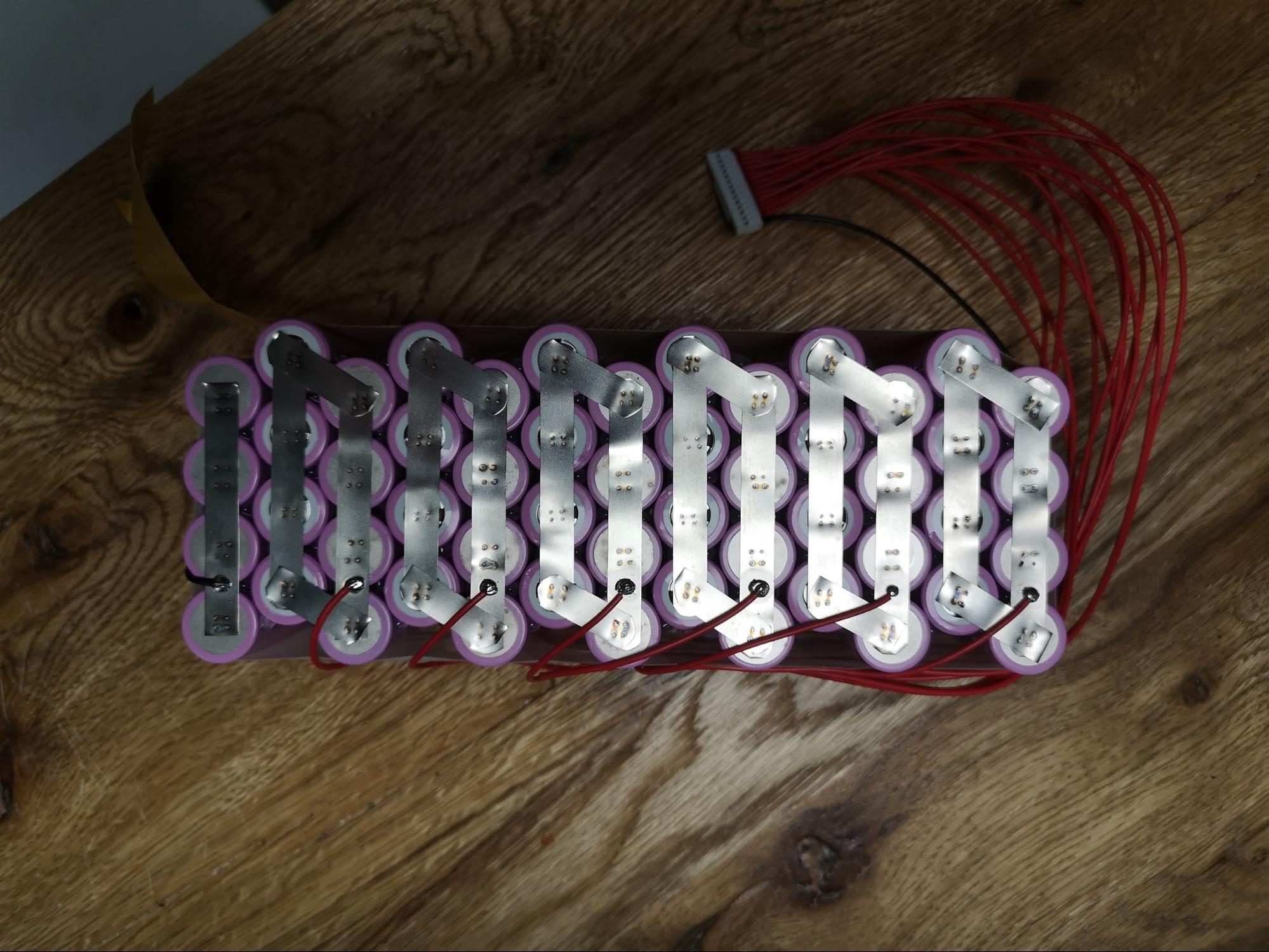
It is one of the questions we hear most often: “The test shows only one group is weak, can’t you just replace those cells?” The answer is no, and it is not to sell you more cells. Here is why.
The weakest group controls the whole pack
As explained in our article on how a lithium-ion battery works, a battery is made of cell groups connected in series. The same current flows through every group, and the BMS shuts the battery down as soon as one single group reaches its limit.
When a group fails, it is rarely an isolated accident: it is simply the first one to reach the end of its life. The other groups are the same age, have done the same number of cycles and gone through the same winters and summers. They are just slightly behind. Replacing the first one only makes room for the next.
Mixing new and worn cells creates an imbalance
Imagine replacing a single group with new cells in a five-year-old battery:
- Different capacity: the new group holds, say, 3.4 Ah, the old ones only 2.5 Ah. On every discharge, the old ones run out first; the BMS cuts off, and the new group is never fully used. You pay for new cells and keep the range of the old ones.
- Different internal resistance: a worn cell heats up more and sags more under load, on hills or when pulling away. The old groups fall below the cut-off threshold while the battery is still half full: the battery shuts down suddenly.
- Faster ageing: the old groups, working harder, degrade even faster. The imbalance grows with every cycle.
The BMS balancing cannot make up for it
The BMS can balance the groups at the end of charging, but only with a very small current (often a few tens of milliamps). It corrects small differences between cells of the same age, not the gap between a new group and a worn one. The result: voltages drift apart, the BMS trips into protection more often, and the charge indicator becomes unreliable.
A matter of safety and quality
Opening a battery and desoldering and re-welding among old cells is not trivial: worn cells tolerate handling less well, and the existing welds have already aged. A pack rebuilt entirely with new cells of the same brand, model and batch is uniform: every group has the same capacity and resistance, and the BMS can do its job properly.
What about the price?
In a battery repair, most of the cost is labour: opening the casing without damaging it, dismantling, preparing the welds, reassembling, testing. Replacing a single group would cost barely less than a full pack, for a battery that would be back in the workshop a few months later, with a second bill.
By replacing all the cells, you leave with a battery that behaves like new, often with equal or higher capacity than the original thanks to today’s cells. We keep the original casing, connector and BMS, which preserves compatibility with your bike.
In short
- One weak group signals that the whole pack is tired, not just that group.
- Mixing new and worn cells wastes the new ones and makes the old ones age even faster.
- A uniform, fully new pack is the only lasting repair.
Want to know your battery’s real condition before deciding? Bring it in for a diagnosis and capacity test.