

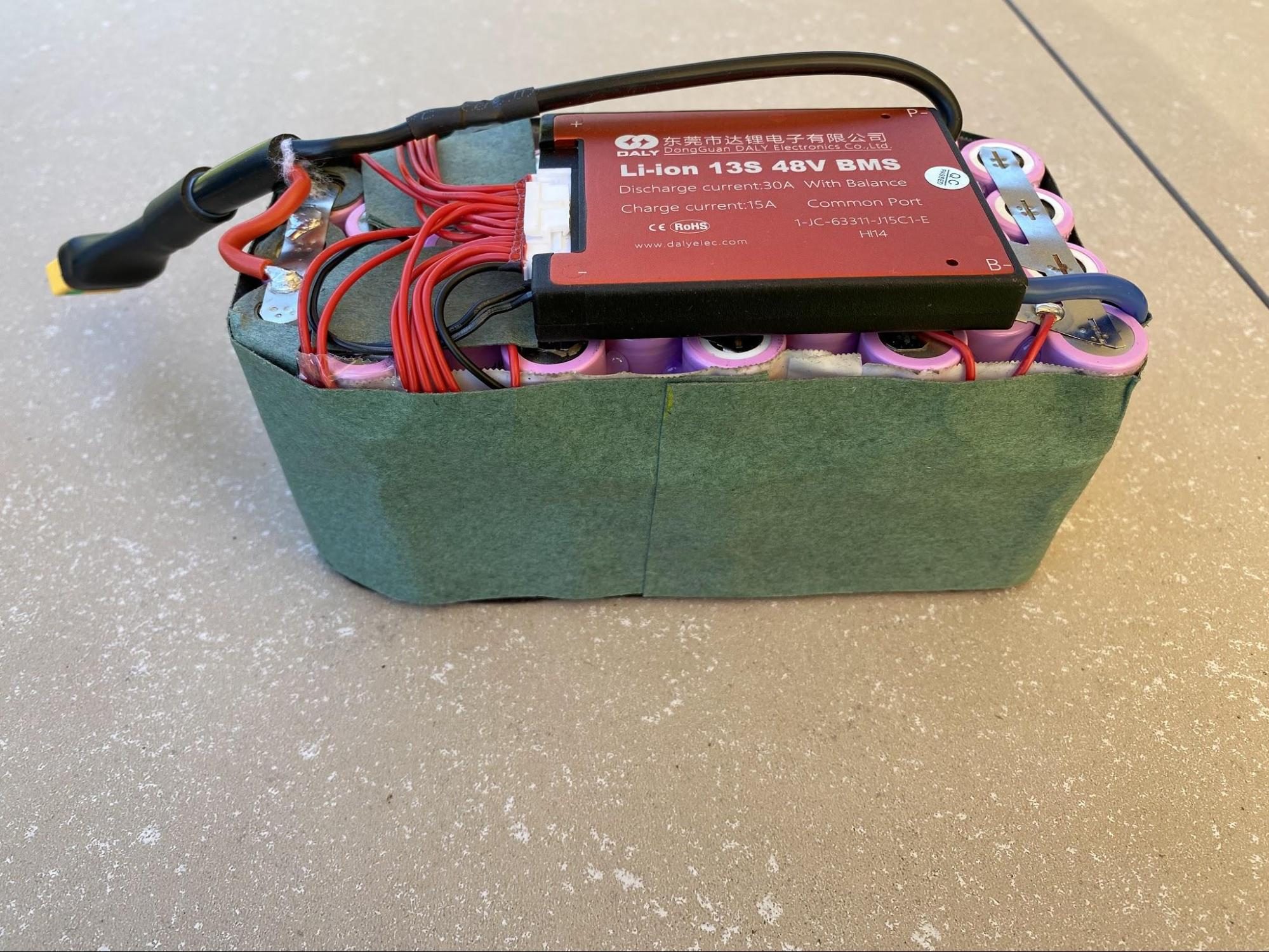
Under its plastic or aluminium casing, your e-bike battery is not one big accumulator: it is an assembly of dozens of small cells, connected together and monitored by an electronic board, the BMS. Here is how it all works.
The cell, the basic building block
Most batteries for e-bikes, e-scooters and power tools are made of cylindrical cells that look like large AA batteries:
- 18650: 18 mm in diameter, 65 mm long, 2.5 to 3.5 Ah;
- 21700: 21 mm in diameter, 70 mm long, up to about 5 Ah.
A lithium-ion cell has a nominal voltage of 3.6 to 3.7 V. It is full at 4.2 V and must not drop below roughly 2.5 to 3 V, or it will be damaged. This narrow range is what makes electronic monitoring essential.
In series: voltages add up
A single cell is not enough to drive a motor, so several are connected in series (the + of one to the − of the next): their voltages add up. The number of cells in series is written with an S:
| Layout | Nominal voltage | Fully charged |
|---|---|---|
| 7S | 24 V | 29.4 V |
| 10S | 36 V | 42 V |
| 13S | 48 V | 54.6 V |
| 14S | 52 V | 58.8 V |
That is why a “36 V” battery reads 42 V on a multimeter straight off the charger.
In parallel: capacities add up
For more range, several cells are connected in parallel (all + together, all − together). The voltage stays the same, but the capacities add up. The number of cells in parallel is written with a P.
These parallel cells form what is called a group. Within a group, the cells are welded together and behave like one large cell: they always share exactly the same voltage.
Reading a battery: the 10S4P example
A 10S4P battery has 10 groups in series, each made of 4 cells in parallel: 40 cells in total. With 3.5 Ah cells:
- voltage: 10 × 3.6 V = 36 V;
- capacity: 4 × 3.5 Ah = 14 Ah;
- energy: 36 V × 14 Ah = 504 Wh.
Watt-hours (Wh) are the real measure of range: that is the figure to compare between two batteries.
How a pack is built
In a well-made pack:
- cells are joined with spot-welded nickel strips: a very short electrical pulse that does not heat the cell. A cell is never soldered with a soldering iron, as the heat would damage it;
- insulators (rings and insulating paper) protect the cell edges against short circuits;
- each group is connected to the BMS by a balance wire, so it can measure that group’s voltage;
- one or more temperature sensors are glued between the cells;
- everything is held by cell holders, protected by heat-shrink and fitted into the casing.
The BMS, the battery’s brain
The BMS (Battery Management System) is the electronic board that monitors the pack at all times. Its jobs:
- overcharge protection: it stops charging if a group goes above about 4.2 V;
- deep-discharge protection: it cuts the output if a group drops too low;
- overcurrent and short-circuit protection;
- temperature monitoring: it stops charging or discharging if the pack is too cold or too hot;
- balancing: at the end of charging, it brings all groups to the same voltage by bleeding a little energy from the fullest ones.
Key point: the BMS works group by group. As soon as one single group hits its limit, it shuts down the whole battery. The weakest group therefore sets the range of the entire pack.
On branded batteries (Bosch, Shimano, Yamaha, Stromer…), the BMS does even more: it counts cycles, stores the battery’s history and communicates with the motor and display. More on this in our article on BMS lockouts and communication errors.
Key takeaways
- A battery is cells in series (voltage) and in parallel (capacity).
- Parallel cells form groups; the weakest one limits the whole pack.
- The BMS protects the cells and balances the groups: without it, a lithium battery would be dangerous.
Want to know the condition of your battery’s groups? Our capacity test tells you precisely.