

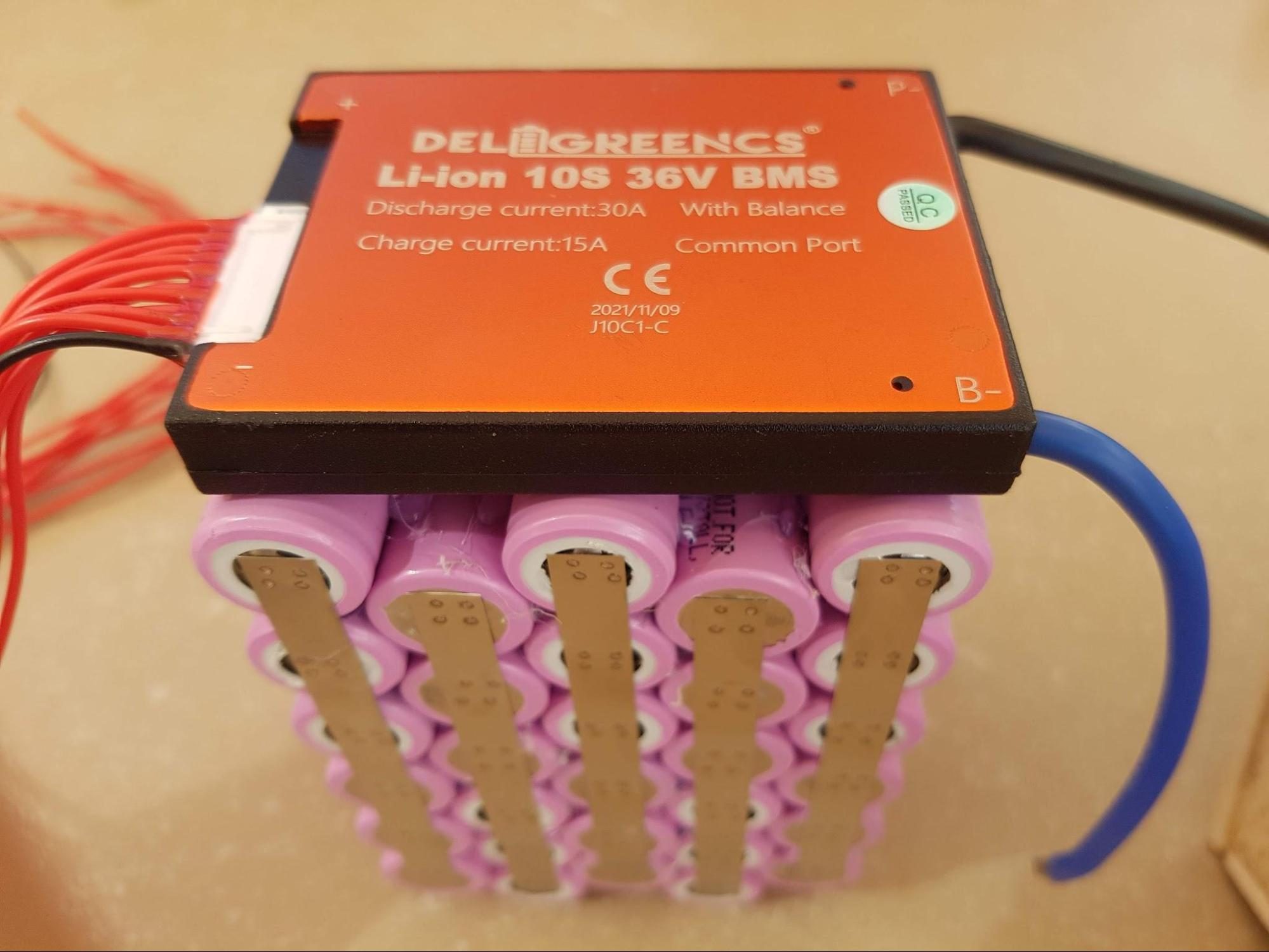
An electric bike battery isn’t a ‘black box’: inside, everything is organised and can be measured. Here’s what it contains and what we look at in the workshop when a battery starts to lose its charge.
What’s inside the casing
An electric bike battery consists of a few components that are easy to identify:
- Lithium-ion cells: these are small, cylindrical rechargeable batteries, connected to one another, which store energy.
- The BMS (Battery Management System): an electronic circuit board that monitors the entire system and protects the battery.
- The connections: soldered metal strips that link the cells to one another and to the circuit board.
- The casing and connector: these protect the battery pack, secure it to the bike and ensure contact with the motor and the charger.
These cells are assembled to achieve the desired voltage and capacity. A lithium-ion cell provides a nominal voltage of approximately 3.6 to 3.7 V. By connecting groups of cells in series, the standard voltages used in electric bikes, such as 36 V or 48 V, can be achieved. Adding cells in parallel increases the capacity. For a detailed explanation of this principle, our guide How a lithium-ion battery works explains it step by step.
The role of the BMS
The BMS acts as the battery’s guardian. In particular, it monitors the voltage of the cell groups, cuts off the power supply in the event of an abnormal situation and, depending on the model, communicates with the e-bike and the charger.
This is useful, but it also means that a battery may refuse to work even though its cells are in good condition. Conversely, a BMS that is working perfectly cannot compensate for worn-out cells. It is therefore necessary to examine both, and not jump to conclusions. We have discussed this scenario in detail in BMS lock-up and communication errors.
What we check at the workshop
When a battery is brought to us, we carry out a series of tests before giving you our assessment:
- The battery voltage and that of the cell packs: an abnormal difference between packs is a significant indicator.
- The condition of the BMS: is it responding, communicating and providing protection correctly?
- Actual capacity, determined by a capacity test, which indicates how much power the battery can actually deliver.
- The connections, the connector and the casing: a poor connection or a damaged casing can also explain unusual behaviour.
| Component | What it does | What we check |
|---|---|---|
| Cells | Store energy | Voltage, balance between groups, capacity |
| BMS | Monitor and protect | Operation, communication |
| Connections | Link cells to electronics | Condition and continuity |
| Housing and connector | Protect and power the bike | Contacts, wear and tear, damage |
When symptoms appear
A decreasing range, the bike cutting out on a hill, a battery that no longer takes a charge or won’t wake up: these symptoms can have several possible causes. Cold weather, for example, temporarily reduces range without the battery being faulty (see Electric bikes in cold weather). Only a test can distinguish between a temporary effect and actual wear and tear.
A battery that has been left discharged for a long time may seem beyond repair. However, a deeply discharged battery can often be salvaged. So don’t write it off as completely unusable before having it checked.
Why not open it yourself?
A lithium-ion battery contains a great deal of energy. Incorrect handling, a short circuit or an unsuitable charger can damage it and pose a hazard. We recommend that you never open, repair or recharge a battery pack yourself if you have any doubts: take it to the workshop.
If a repair is needed
If the diagnosis shows that the cells are worn out, we replace all the cells in the pack – never just a single group – as cells of different ages would not work well together (see Why we don’t just replace the worn-out cells). We retain the original casing, connector and BMS, which we keep powered throughout the repair.
Each battery then undergoes a capacity test. You will receive a certificate and a QR sticker, which allows you to view its details on the [My Battery] page (/ma-batterie/).
You can drop off your battery at the workshop in Prilly, or send it to us by post after contacting us: there are specific packaging requirements, and we’ll let you know how to proceed.
In summary
- A battery contains lithium-ion cells, a BMS, connections, a casing and a connector.
- The BMS protects the battery, but it is no substitute for good cells, and a malfunctioning BMS does not necessarily mean the cells are worn out.
- We carry out measurements before reaching a conclusion: voltages, BMS, capacity and connections.
- Never open a battery yourself: take it to the workshop.
Does your battery seem to be losing its charge? Contact us or find out about our refurbishment and repair service to have it checked at the workshop.