

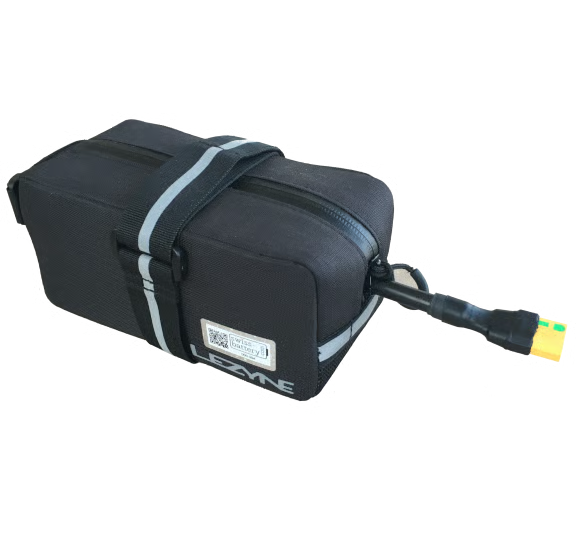
On the label of an electric bike battery, you’ll find figures such as ‘36 V’ and ‘14 Ah’, and sometimes ‘504 Wh’ too. These figures aren’t just for show: they allow you to compare two batteries and estimate what you can reasonably expect when out and about. With the end-of-year sales approaching, it’s worth knowing how to interpret them.
Three units, three roles
- Volts (V): the battery’s voltage. This depends on the number of cell groups connected in series.
- Ampere-hours (Ah): the electrical charge capacity, i.e. the amount of current the battery can supply over a certain period of time.
- Watt-hours (Wh): the actual energy stored. This is calculated simply as: Wh = V × Ah.
The most useful figure for comparison is therefore the watt-hour. Two batteries with the same capacity in Ah may contain very different amounts of energy if their voltage is not the same.
A practical example
A ‘36 V 14 Ah’ battery contains approximately 36 × 14 = 504 Wh. If the label states ‘10s4p’, this means that 10 groups are connected in series (which determines the voltage) and that each group comprises 4 cells connected in parallel (which determines the capacity). We explain this design in our guide on how a lithium-ion battery works.
The voltages shown are nominal voltages. In reality, a lithium-ion cell varies from around 4.2 V when fully charged to around 3 V when fully discharged:
| Configuration | Nominal voltage | Voltage at full charge |
|---|---|---|
| 10 cells in series (10S) | 36 V | approx. 42 V |
| 13 cells in series (13S) | 48 V | approx. 54.6 V |
From energy to range
Range is simply the available energy divided by the energy consumed per kilometre. For example: if your bike consumed an average of 10 Wh per kilometre, a 500 Wh battery would take you about 50 km. This figure is an example, not a guarantee: consumption varies greatly depending on usage.
In particular, it increases with:
- the assistance level selected;
- the total weight (cyclist, luggage);
- hills and headwinds;
- speed and frequent stops;
- tyre pressure that is too low;
- cold weather, which temporarily reduces the battery’s output (see why range decreases in cold weather).
Why the advertised range is rarely what you actually get
The ranges advertised are generally measured under favourable conditions: flat terrain, moderate assistance, mild temperatures. Your daily journey on hills, in Lausanne or elsewhere, will yield different results. Please regard these figures as a guide for comparison, not as a guarantee.
Original capacity and actual capacity
The Wh figure on the label corresponds to a brand-new battery. Over the years and through charging cycles, the cells gradually lose capacity: the battery remains usable, but it stores less energy. This is one of the reasons why the range decreases over time.
To find out how your battery is performing, the charge indicator isn’t enough: it’s only an estimate. Only a capacity test measures how much power the battery actually delivers. Every battery we service undergoes this test, and comes with a certificate and a QR sticker that lets you access its details on the [My Battery](/ma-batterie/ page.
Before buying or having a battery reconditioned
- Compare in Wh, not just in Ah, and check the voltage.
- More Wh also means more weight and more space required: the casing and the electronics set limits.
- Be wary of promises based on figures that do not specify the voltage or the measured capacity.
- If your range has dropped significantly, do not open the battery: a lithium battery should not be handled carelessly. Take it to a workshop for a diagnosis.
In summary
- Wh = V × Ah: this represents energy, and is therefore the best figure for comparison.
- Range depends as much on how you use it as on the battery itself.
- The capacity stated is that of a new battery: it decreases over time.
- Only a capacity test will give the actual value.
If you feel your e-bike’s range has decreased, find out about our diagnostic and reconditioning service and bring your battery to us in Prilly for a capacity test.